Custom De‑Escalation Training Programs for Companies – Book Now
Tense moments in your organization can happen in the form of a frustrated customer, distressed patient, or an angry coworker. It is pretty much any situation that escalates quickly before anyone has time to think. In those moments, the outcome depends on whether your team knows how to respond in real time.
At Defuse De-escalation Training, we help organizations prepare their employees to be ready for when the inevitable happens. Our custom de‑escalation training programs give your team practical, proven tools they can use when emotions run high. Through industries including healthcare, education, customer service, law enforcement officers, and corporate environments, we tailor every training program to the real situations your people face on the job.
What Is De‑Escalation?
De‑escalation, by definition, is the ability to interrupt a conflict that has already started and prevent it from getting worse. The process focuses on calming heightened emotions, reducing risk, and creating enough stability for communication to move forward safely. In many cases, the goal isn’t to get an immediate resolution but, rather, to restore enough control to make sure no one is harmed as you continue the interaction.
Why De‑Escalation Matters in Conflict Resolution
When we approach a situation from a position of conflict resolution, we usually assume that people are ready to talk. On the other hand, when we focus on the de‑escalation meaning, it recognizes that this is not always true and often occurs before conflict resolution is an option. When someone is emotionally escalated, logic alone just won’t work, and without the right skills, even the most well‑intentioned responses can actually have the opposite effect and end up increasing tension, stress, or safety concerns.
De‑escalation skills give your team the ability to slow situations down so that does not happen. It reduces workplace violence risk, supports mental health, and protects both employees and community members during high‑stress interactions.
Pillars of Effective De‑Escalation Techniques
Effective de‑escalation is built on a few core elements that show up across industries. These skills are built through consistent practice and the right support.
Situational Awareness
Spotting conflict early gives you options. When teams learn to recognize subtle changes in tone, body language, and behavior, they can intervene early enough to influence the outcome. This proactive mindset builds consistency in how conflict is managed, which is one of the core goals of any successful de-escalation training.
Emotional Self-Regulation
Staying centered is far more powerful than pushing back when emotions run high. Emotional self-regulation allows you to manage your own stress response so you can lead with calm instead of control. Defuse’s model encourages patience and intentionality through improved emotional intelligence, which increases psychological safety across your team.
Active Listening and Communication
You can’t de-escalate what you haven’t understood. Practical active listening techniques are the best way to get below the surface of a conflict. You can stay present, paraphrase for clarity, and ask questions that won’t put the other person on the defensive throughout what is already a stressful interaction.
Respectful Body Language and Presence
What you do with your face, hands, and posture can de-escalate the situation or intensify the situation before a word is ever even spoken. Maintaining a neutral but engaged presence makes it easier for everyone else involved to stay open instead of reactive. You need to approach tense moments with intentional, non-threatening body language that supports your message.
Custom De‑Escalation Training Programs Offered by Defuse
No two workplaces experience conflict in the same way. That is why Defuse designs custom de‑escalation training programs rather than relying on generic content. Every workshop is built around your environment, your people, and your real‑world challenges.
Program Customization Across Industries
We work with organizations across government, healthcare, education, corporate offices, customer service teams, law enforcement, security, and more. Each sector faces different types of escalated situations. A hospital unit managing distressed patients requires different tools than a retail team handling aggressive customer interactions or a school addressing student behavior.
Our trainers adapt the training program to match those realities. Scenarios, language, and practice exercises reflect the situations your employees actually encounter. This makes learning immediately applicable instead of theoretical.
Core Components and Training Approach
Every Defuse program is built around proven methods for reducing workplace aggression and improving safety under pressure. While each session is customized to your team’s setting and risk profile, the core framework remains focused and practical across industries. Our approach builds psychological readiness, improves individual responses, and effectively prepares your team to de-escalate high-tension situations by giving them the right skills and confidence.
Understanding Conflict and Aggressive Behavior
Since you can’t resolve what you don’t understand, we start with a deep dive into the psychology of aggression and the common patterns behind workplace conflict. We help your team recognize how stress, fear, and perceived threats can lead to escalation and then how to spot those signals before behavior turns unsafe. This knowledge gives employees a solid foundation for interpreting high-pressure moments and replacing panic responses with responses centered in clarity.
Practicing Emotional Self-Regulation
Staying calm in the face of aggression is a learned technique. We teach practical emotional self-regulation strategies that help employees manage adrenaline, anxiety, and reactive impulses in real time. These tools are useful for frontline staff who very commonly encounter unpredictable behavior or emotionally charged situations. Learning how to stay centered puts your team in a better position to lead others out of conflict and prevents them from getting pulled into it.
Mastering Verbal De-Escalation Techniques
Defuse’s de-escalation training online also focuses on specific, field-tested verbal de-escalation techniques that shift energy, reduce defensiveness, and guide people toward safer interactions. We teach how to use voice tone, phrasing, and body stance in combination to calm potentially aggressive or violent people down. These skills are immediately actionable and have been proven to reduce the risk of physical confrontation in a wide range of settings.
Key Elements of Defuse’s Training Programs
Defuse offers flexible training formats and ongoing support so learning does not stop when the session ends.
In‑Person, Online, and Hybrid Training Options
We deliver de‑escalation training workshops in person, virtually, or through hybrid models, depending on your needs. Some organizations prefer hands-on, in‑room training, while others benefit from online courses or e‑learning formats that allow teams to learn across locations. We also offer asynchronous options for busy professionals who need flexible scheduling. No matter the format, our custom de-escalation training remains interactive and grounded in practice.
Assessment and Follow‑Up Support
Training effectiveness improves when learning continues beyond the workshop. Defuse offers assessment tools, reinforcement training materials, and follow‑up support to help teams apply their new skills consistently. This may include refresher sessions, coaching, or additional training for managers and supervisors. The goal is to create lasting behavioral change that supports safety and effectiveness over time.
Benefits of Implementing Custom De‑Escalation Training
Organizations that invest in de‑escalation training see benefits that extend beyond conflict moments, including:
A Healthier, More Productive Work Environment
When employees know how to respond to escalated situations, stress levels decrease, and then fewer incidents spiral out of control. As a result, teams feel safer at work, which improves morale and reduces burnout. This is because a calmer environment supports productivity, where your employees can focus on their roles instead of worrying about how to handle tense encounters that they think might pop up at any second.
Stronger Communication and Team Dynamics
De‑escalation training strengthens communication skills across teams. Participants learn how word choice, tone, and body language influence outcomes. They practice listening without escalating defensiveness and by responding with clarity under pressure. This makes it easier to work as one cohesive unit.
Greater Confidence in Handling Difficult Situations
Training provides your employees with conflict response skills they can rely on in unpredictable moments. Whether it’s a frustrated customer or a tense coworker interaction, they’re a lot less likely to freeze or react impulsively. That confidence reduces hesitation in the moment that could be costly and improves outcomes across all roles. When people trust their ability to stay safe and effective, your organization becomes more resilient.
Reduced Risk of Workplace Aggression
Custom de-escalation programs are tailored to the real challenges your teams face. This alignment makes the training more relevant and more likely to prevent workplace aggression. By addressing behavioral triggers early, employees can avoid letting minor tensions escalate into full-blown incidents. Over time, these strategies contribute to a safer workplace with fewer reactive interventions.
Higher Retention and Organizational Stability
Employees who feel psychologically safe are more likely to stay at your company. When workers know their employer takes safety, communication, and emotional support seriously, loyalty increases. De-escalation training sends a clear message that you invest in people as part of your workplace culture, not just productivity. That investment pays off in stronger retention, lower turnover, and more stable teams over time.
How to Choose the Right De‑Escalation Training Program
Not all training programs offer the same level of depth or relevance. Choosing the right partner matters.
Key Factors to Consider
Look for programs led by experienced, expert practitioners rather than general trainers. Training should address real‑life scenarios from your industry and not just use the same general training for everyone. Flexibility in delivery formats matters, especially for large or distributed teams. Customization is essential. A program that adapts to your organization will be far more effective than a one‑size‑fits‑all approach.
Questions to Ask Training Providers
- Ask how training is tailored to your specific risks.
- Inquire about follow‑up support and reinforcement.
- Understand who will be leading the training and their experience in de‑escalation work.
At Defuse, our typical custom engagements start at $5,000. We are transparent about scope and expectations so you can make informed decisions.
Why Organizations Choose Defuse
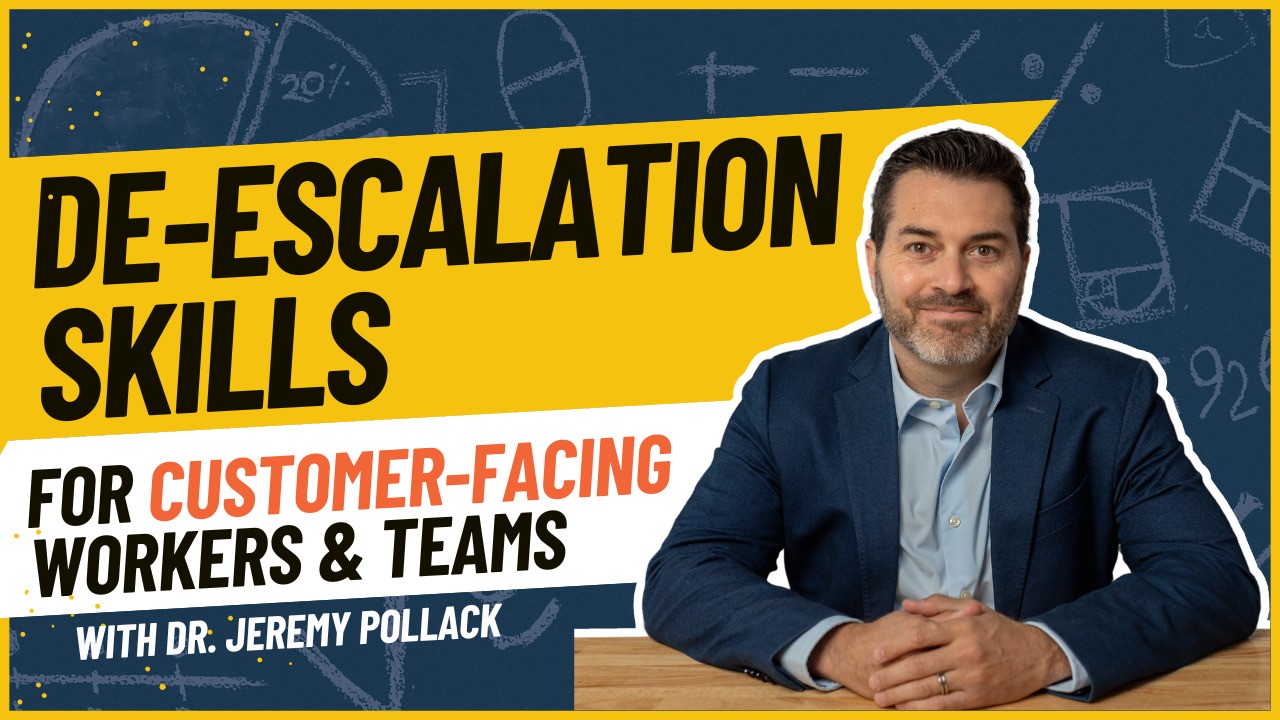
Defuse is the exclusive de‑escalation training brand under Pollack Peacebuilding Systems, the largest workplace conflict management firm in North America. Founded by social psychologist Dr. Jeremy Pollack, our programs draw on decades of combined experience training organizations across more than 80 industries.
Our workshops are built by conflict experts and delivered by specialists who work with escalated situations every day. We focus on what works in real‑world conditions. That is why organizations across the country trust us to train their teams.
Get Started With Custom De‑Escalation Training
If your employees interact with customers, patients, students, clients, or community members, de‑escalation training is not optional. It supports safety, confidence, and effectiveness at every level of your organization. Whether you are addressing a current issue or preparing proactively, we can help you build a training program that fits your needs. Contact us to discuss your goals, explore training options, and begin creating a safer, more productive workplace.