Every conversation at work carries two messages, the words people say and the signals their bodies send. Most people don’t think about their posture or expression while they talk, and under stress, those signals can shift without you noticing.
Positive body language is a set of learnable habits that can help coworkers, patients, students, and customers feel heard. This guide covers what it looks like, examples you can use, cultural differences, and how to stay open in tense conversations.
What Is Positive Body Language?
Positive body language is the set of nonverbal signals that tell people you’re approachable, paying attention, and safe to talk to. It includes an open posture, a relaxed face, appropriate eye contact, nodding, and a respectful distance.
Everyone sends these signals, usually without thinking about them. Stress can make them harder to manage, and the American Psychological Association notes stress can show up as muscle tension in the shoulders and neck.
The often-quoted claim that 55% of communication is body language comes from Albert Mehrabian’s 1967 experiments on how people read feelings and attitudes. Those studies looked at liking and disliking when someone’s words and facial expression conflicted. In Mehrabian’s own explanation, he writes, “Unless a communicator is talking about their feelings or attitudes, these equations are not applicable.”
Body language works alongside what you say. It’s a way of showing interest in someone’s perspective and emotions, and it can contribute to the psychological safety people need to speak up.
What Open Body Language Looks Like
Open body language signals that you’re ready to listen. In everyday conversations, common advice is to sit or stand with your shoulders relaxed, arms uncrossed, and your body turned toward the person. Vanderbilt University Medical Center’s de-escalation guidance similarly describes a relaxed, open stance.
Crossed arms and turning away are often read as closed signals. Project BETA guidance on agitated patients, from the American Association for Emergency Psychiatry, notes that closed body language “can communicate lack of interest.” These cues can also mean something simpler, such as feeling cold, tired, or comfortable.
The same Project BETA guidance, published in the Western Journal of Emergency Medicine, advises keeping hands visible and not clenched. It also advises standing at an angle to an agitated person rather than squarely facing them. Read cues together and in context, and our guide to reading body language at work explains how.
Openness can be as small as a turn of the chair. At a nurses’ station or service desk, turn your chair or torso toward someone before they finish their first sentence. That small shift can show you’re ready to hear what’s beneath the surface.
Positive Body Language Examples
The positive body language examples below each pair a signal with a moment when it can help.
- Smile genuinely when you greet someone, so they can see you’re glad to talk with them.
- Keep eye contact balanced while someone speaks, glancing away naturally so it doesn’t become a stare.
- Nod occasionally as someone explains a problem to show you’re following along.
- Lean slightly forward in one-on-one conversations to show interest in what the other person is saying.
- Relax your face while you listen to feedback or a complaint, so your expression stays neutral and open.
- Gesture with open palms when you explain a next step, instead of pointing at the person.
Each of these tells the other person how you’re receiving them, and a few have research behind them.
Smiles that involve the eyes, called Duchenne smiles, tend to read as warmer than polite smiles. In research published in PNAS Nexus, Witkower and colleagues cite a meta-analysis concluding that Duchenne smiles are perceived as more authentic and trustworthy. These are perception ratings, so a smile is a signal people read and can’t prove what someone feels.
Eye contact follows a similar pattern. The authors of a study in PLOS ONE summarize earlier research showing that someone who makes eye contact tends to be rated as more likable and credible. The same 2013 paper notes that excessive eye contact may make an observer uncomfortable.
Nodding can be a subtle way to show you’re listening. The Stanford Report, in a May 2025 piece on active listening, lists nodding, maintaining eye contact, and removing distractions as ways to show you’re engaged. Try nodding at natural pauses rather than continuously.
Hand gestures deserve the same attention. Think about how you can adjust your hand movements to be more purposeful rather than fidgety. Clicking a pen or tapping a desk can pull attention away from what someone is telling you.
Positive vs. Negative Body Language
Positive body language and negative body language often differ by small adjustments to the same signal. The table below compares common cues, though any single cue can mean different things in different contexts.
| Signal | Positive version | What can read as negative |
|---|---|---|
| Posture | Upright, relaxed, and turned toward the person | Slumped or turned away |
| Arms | Uncrossed and resting naturally | Tightly crossed |
| Eyes | Steady, comfortable eye contact | Staring or avoiding eye contact |
| Face | Relaxed, with a genuine smile when it fits | Frowning or eye-rolling |
| Hands | Visible, with open palms and calm gestures | Pointing, fidgeting, or hidden |
| Distance | Comfortable personal space | Standing closer than the other person seems comfortable with |
| Head | Occasional nods while listening | Head shaking or looking at a phone |
Mismatched signals can confuse people. For example, crossing your arms while saying you’re open to feedback sends mixed messages. Mehrabian’s experiments suggest that when words and facial expressions conflict about feelings, listeners may lean on the face.
If you say, “I’m open to feedback,” keep your arms uncrossed and pause long enough for the other person to answer. Our article on giving nonverbal feedback covers more ways to align your words and body.
Cultural Differences in Body Language
Body language can carry different meanings across cultures. According to the Paul Ekman Group, Ekman’s research points to seven facial expressions of emotion recognized across cultures, though experts continue to debate this. Elfenbein and Ambady’s 2002 meta-analysis in Psychological Bulletin found better-than-chance recognition of emotions across groups, with higher accuracy within the same cultural group.
In different cultures, the norms around eye contact vary; in some, it’s a sign of respect, while in others, prolonged eye contact may be considered aggressive. In the same PLOS ONE study, Japanese participants rated faces making eye contact as angrier and less approachable than Finnish participants did. The PLOS ONE comparison involved 40 university students, so it points to variation without describing whole cultures.
Curiosity, one of the 5 Core Competencies in the Theory of Peaceful Leadership, can help here. Watch how others greet each other, ask what’s comfortable when you’re unsure, and treat a single cue as a question to explore.
Using Positive Body Language in Tense Conversations
A calm body can help lower the temperature when someone is upset. Positive body language in these moments makes room for the other person’s emotions and needs, which is central to a transformative, interest-based approach to conflict.
Vanderbilt University Medical Center’s verbal de-escalation guidance lists a relaxed, open stance, a body turned slightly, open hands, good eye contact, and a concerned look. That one medical center’s guidance also advises moving slowly.
The steps below can work together in a single conversation, starting with your own state.
- Settle your own body first by slowing your breathing and relaxing your shoulders before you respond.
- Keep extra distance with an agitated person, since the Project BETA guidance recommends at least two arm’s lengths and Vanderbilt’s advises asking before stepping closer.
- Use calm, open-handed movements to guide the conversation rather than pointing or waving.
- Pair your posture with words that acknowledge how the person feels, then invite them to explain.
A phrase such as “I can see this has been frustrating. Walk me through what happened.” gives the person room to talk while your body stays calm. Your own stress can show in your posture and voice, and our guide to regulating your emotions at work offers ways to stay steady.
It also helps to notice when someone’s tension is rising. OSHA’s hospital eTool lists warning signs of increasing anger, including pacing, clenched fists, and increasingly loud speech. If there’s an immediate threat of violence or serious harm, step away and follow your organization’s emergency procedures.
Body language supports safety and never replaces your workplace’s safety protocols or support from security and HR. For what to say once things are calmer, these steps to de-escalate a situation walk through the process.
How to Practice Positive Body Language
Positive body language can improve with small, repeated adjustments. Before meetings or shifts, relax your shoulders, uncross your arms, and notice whether your jaw is tight.
On video calls, look at the camera when you make a key point, since that’s where the other person sees your eyes. Keep your hands visible in the frame when you gesture.
Ask a trusted colleague for feedback after a meeting. A question such as “Did I seem open when the team raised concerns?” can surface habits you can’t see yourself.
Finally, notice your default under stress, whether that’s crossing your arms, looking at a screen, or speeding up your speech. At Peaceful Leaders Academy, we encourage learners to treat this self-awareness as a skill they can build through practice and reflection.
Frequently Asked Questions
What Are 5 Examples of Positive Body Language?
Five examples of positive body language are a genuine smile, balanced eye contact, occasional nodding, an open posture, and leaning slightly forward. Each one can signal that you’re paying attention.
Can Positive Body Language Be Faked?
Yes, partly. The meta-analysis cited in the PNAS Nexus paper concluded that Duchenne smiles are perceived as more positive even when deliberately posed. Still, gestures that don’t match your words or tone may be noticed, so aim for alignment.
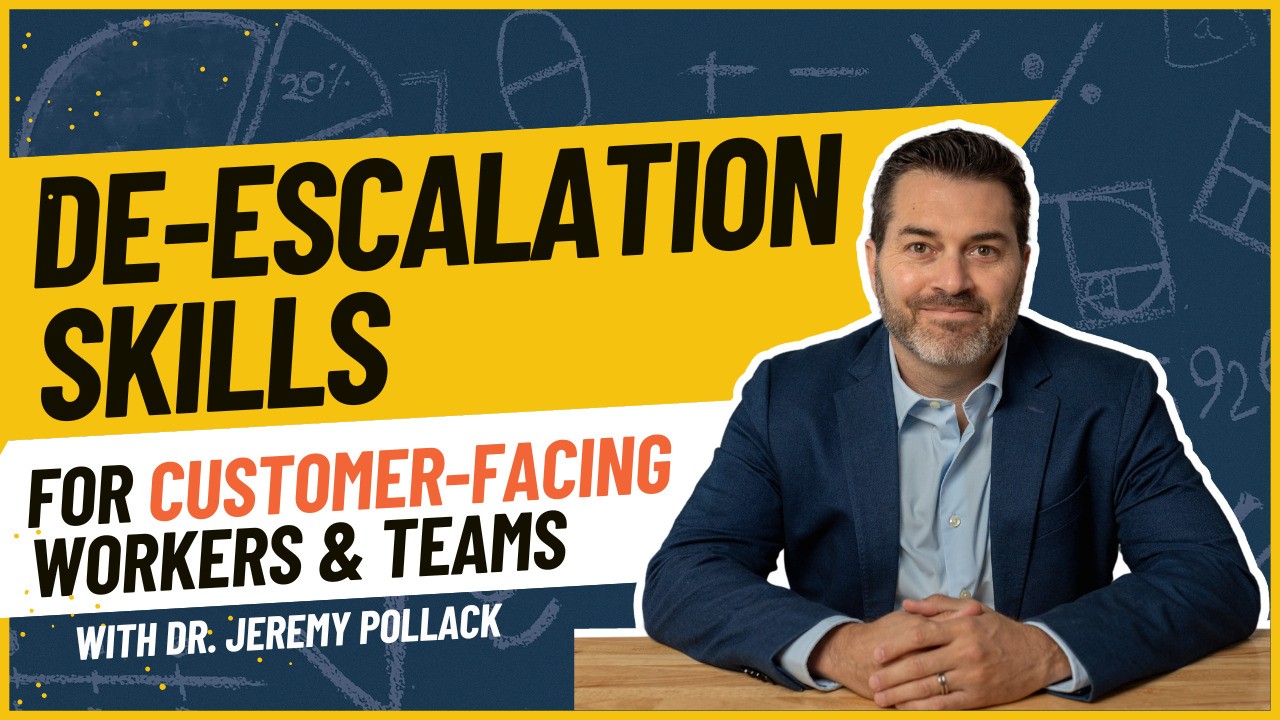
Build Your De-Escalation Skills
Positive body language is one part of staying calm when conversations get tense. The Peaceful Leaders Academy De-Escalation Training course teaches you, in about 90 minutes on demand, to de-escalate emotionally charged individuals while regulating your own emotions. Explore the course to start building these skills at your own pace.