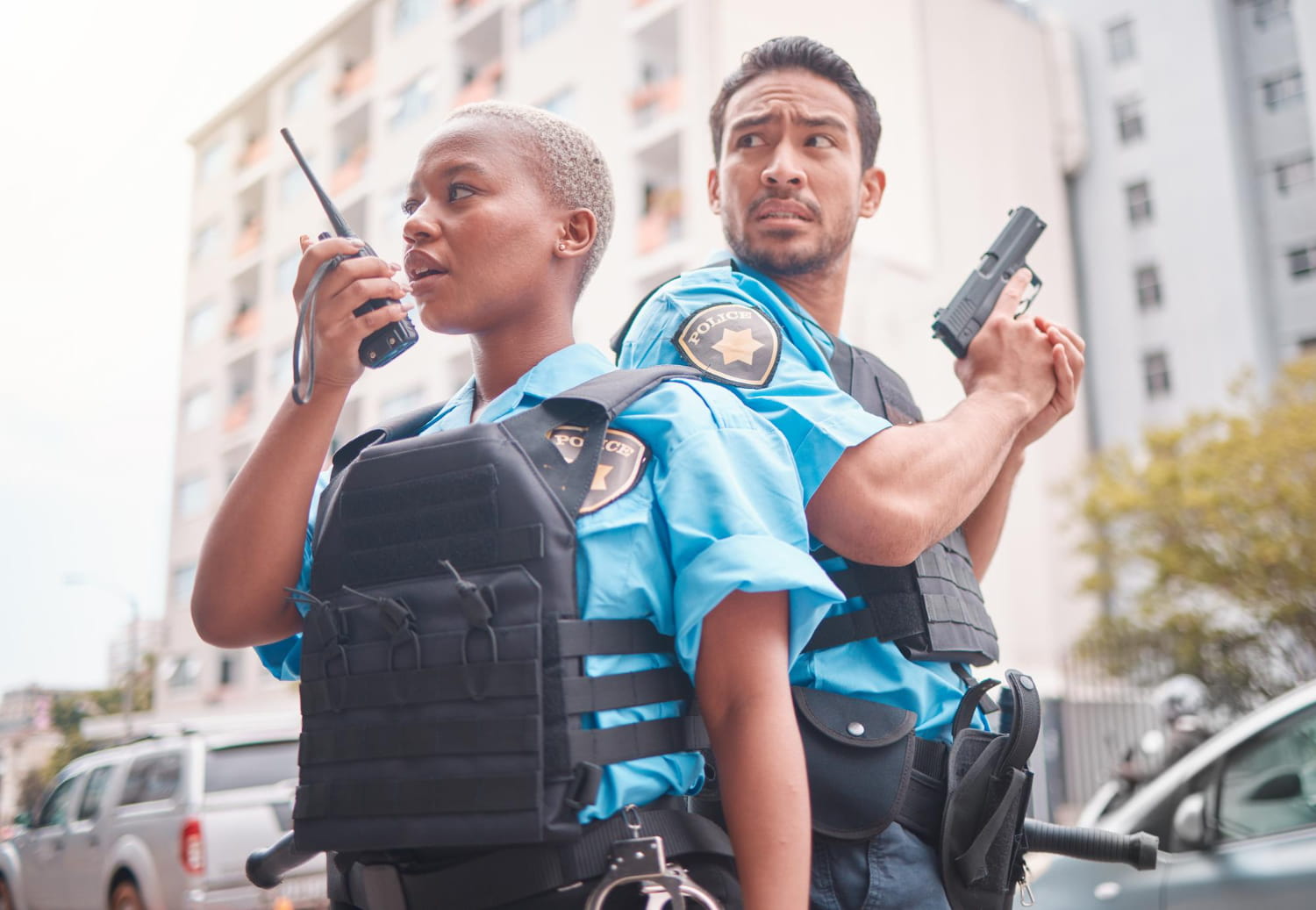
Security professionals work in environments where decisions happen fast and authority has real limits. When the question comes up, can private security use force, the honest answer is yes, but within a narrow legal lane.
Security guards may act when there is an immediate threat to people or property and the use of force is permitted under specific conditions. What it is not is a first move. Reasonable force, applied as a last resort, is the legal standard. De-escalation strategies are the professional standard. Those are two different things, and understanding both is what separates competent security personnel from liability risks.
Do Private Security Guards Have Legal Authority to Use Force?
Private security officers are not police. In most states, private security guards generally have the same authority as private citizens. Their power to act is grounded in self-defense doctrine and the narrow rules governing a citizen’s arrest, not in any special law enforcement standing.
A citizen’s arrest is lawful only in limited situations, typically where a crime is directly witnessed. That is the ceiling on detention authority for most guards. Reasonable force is permitted for self-defense, defense of others, and that narrow category of lawful detention, but it must satisfy both necessity and proportionality.
Excessive force carries civil and criminal exposure, and those legal consequences attach to the individual and employer alike. If your security team needs a clearer framework for where legal authority starts and stops, de-escalation training for security officers builds that foundation.
On lethal force, the bar is high. Serious bodily harm or an immediate threat to life may bring it within the scope of self-defense law in some states, but state laws vary. Lethal force is not a guard prerogative. It is an extreme measure tied to an imminent threat.
How Private Security Differs from Law Enforcement
Unlike law enforcement, private security guards operate without public authority. Law enforcement officers work under statutory powers that security personnel legally do not have. Police officers make formal criminal arrests. Security officers are authorized to detain individuals only under a citizen’s arrest, and their authority typically ends at the property line.
The guard’s role is plain: protect property, control access, maintain order, respond to emergencies, deter crime, and write reports. Deterrence and observation. Security professionals who rely solely on presence and communication first, and call in law enforcement when something moves beyond their scope, are doing the job correctly. Public safety depends on knowing where the hand-off is.

Understanding the Force Continuum for Security Guards
When force is genuinely on the table, the force continuum gives security guards a structured way to think through their options. It does not begin with physical contact.
Mere presence comes first. A calm, visible presence alone can shift the energy in tense situations. When that is not enough, verbal communication follows: verbal warnings, measured pacing, and tone that signals control.
Verbal commands come next if the situation tightens. Physical restraint and physical intervention only enter once verbal tools have been exhausted. Less-lethal tools, like pepper spray or carrying tasers where state licensing permits, come before lethal force, which applies only when a threat to life cannot be stopped any other way.
7 De-Escalation Strategies Every Security Professional Should Know
Security guards are expected to work through de-escalation techniques before physical force becomes a consideration. Seven approaches matter here.
- Control Your Own Emotional State First: Security personnel who stay regulated change the room. A calm guard is harder to escalate against.
- Recognize Warning Signs Early: Identify escalating hostile behavior before it peaks: pacing, a raised voice, and physical agitation. Catching those signals early creates room to de-escalate before the situation demands a harder response.
- Use Verbal De-Escalation Deliberately: Slower speech, open-ended questions, and a non-confrontational tone interrupt aggression before it locks in. Online de-escalation training gives security guards structured practice with these scripts before they need them in the field.
- Practice Active Listening: Paraphrasing concerns and demonstrating understanding are genuine tension-reducers. People de-escalate faster when they believe someone is hearing them.
- Offer Choices Instead of Commands: Aggressive individuals respond better when they retain some sense of control. Hard commands often accelerate aggressive behavior and lock in a standoff.
- Adjust Nonverbal Cues: Body positioning, distance, and eye contact communicate intent before a word is spoken. A non-threatening stance supports verbal de-escalation and signals resolution over confrontation, foundational de-escalation skills that can defuse tense situations early.
- Relocate When the Environment Allows: A quieter space removes stimuli that feed the tension. Environmental conditions are a contributing factor in escalation.
When De-Escalation Fails and Force Becomes Necessary
Some potentially dangerous situations do not resolve through communication. When an imminent threat to life exists, such as when self-defense or defense of others is the only remaining option, force is legally justified. Security guards detain in narrow circumstances: a directly witnessed crime, a risk of serious bodily harm, or bodily harm already in progress.
When force is used, the goal is to stop the threat, not to punish the individuals involved. Physical intervention must stay proportional and stop when the danger does. In serious situations, maintaining safety means contacting law enforcement without delay. Safeguarding people is the job. Once police arrive, they take it from there.
Documentation, Policy, and Proper Training
Security teams without documented policies carry real exposure. Report writing is a core obligation; security guards must document every use of force incident: what happened, why force was used, and the outcome.
Proper training is the other half. BLS data from 2025 shows that on-the-job training was required for over 99.5% of security guards, and most states require licensing. Effective de-escalation training belongs in every guard’s recurring development, not just onboarding. Organizations dealing with deeper conflict resolution patterns often pair field training with workplace conflict coaching to address management dynamics that protocols alone cannot reach.
Conclusion
Use of force in private security is legally bound and, for well-prepared teams, rarely needed. De-escalation is the professional baseline. Maintaining safety starts with the right skills, clear policy, and a security industry culture that takes conflict resolution seriously before things turn physical. Explore online security de-escalation training for security officers at Peaceful Leaders Academy.