Learn important de-escalation skills that can help you deal with stressful situations or a crisis in security settings. PLA’s online training course includes:
- A basic sequence for de-escalating individuals
- Effective tools for emotional self-management
- The basics of escalated conflict
- How to attend to citizens confidently
- Body language and tone awareness skills
Course Description
Our asynchronous Security De-escalation Training Workshop utilizes our industry-leading methods, which have been successfully taught and applied to participants in more than 60 industries around North America, from small retail shops to Fortune 100 companies.
Course Curriculum
- Overview of basic escalated conflict theory, psychology, and neurobiology
- The psychology of aggression and aggressive warning signs
- Practical self-regulation and emotional self-management techniques
- Learn to put positive attention before position or policy enforcement without eliminating policies
- Learn to utilize basic conflict psychology in de-escalating conflicts
- Reflective listening techniques
- How and when to implement humanization during de-escalation
- Preparing for when de-escalation doesn’t work

Dr. Jeremy Pollack
Course Instructor
Dr. Jeremy Pollack is a leader in the field of workplace conflict resolution and peacebuilding. He is the Founder of Pollack Peacebuilding Systems, an international conflict resolution consulting firm. Dr. Pollack coaches and trains executives and employees at a variety of levels and industries, from Fortune 500 companies to major non-profits. He has a Ph.D. in Psychology and an M.A. in Negotiation, Conflict Resolution, and Peacebuilding. Read more about Dr. Pollack HERE.
Security officers are often the first people on scene when conflict, agitation, or potential workplace violence occurs. Whether it’s a retail theft confrontation, a hospital waiting room dispute, or a corporate lobby disturbance, the ability to de-escalate a tense situation before it turns physical is now a baseline professional requirement. Peaceful Leaders Academy provides specialized de-escalation training for security officers built around real scenarios, practical communication tools, and use of force alternatives designed for the environments where security professionals actually work.
Training is available through online de-escalation training modules, live virtual sessions, and onsite workshops, each with a certificate of completion. Here is what the program helps security officers achieve:
- Resolve potential conflicts through verbal de-escalation before physical force becomes necessary
- Maintain safety and control in potentially volatile situations without escalation
- Build confidence and decision-making skills under pressure
- Reduce liability risks and incident reports for their organizations
Why Security Officers Need De-Escalation Training
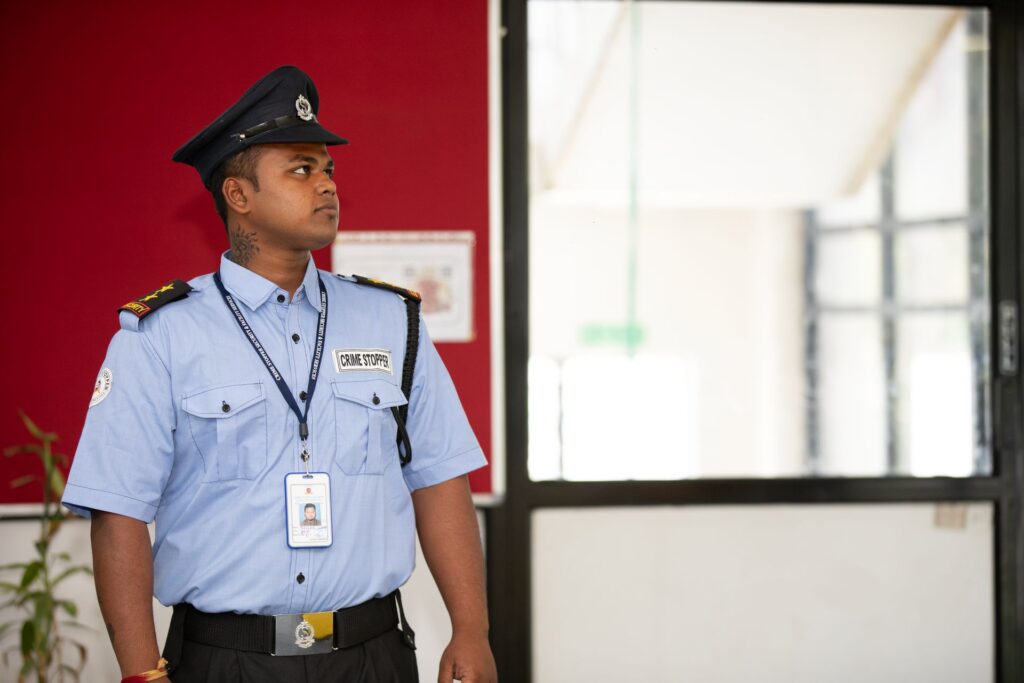
Since around 2020, video-recorded incidents involving security personnel have dramatically increased public scrutiny of how officers handle confrontations. Excessive force can lead to lawsuits and reputational damage, and security personnel may face arrest after aggressive confrontations. These realities mean that escalation training focused solely on compliance and control is no longer sufficient. Modern security officer de-escalation training prioritizes safety, effective communication, and risk assessment alongside physical readiness.
Training in the de-escalation techniques reduces liability risks for security firms and reduces the risk of legal challenges across all client sectors. Clear policies help define when force can be used by security, and de-escalation skills fill the space where verbal tools should come first. Effective de-escalation training protects the organization’s reputation, while peaceful conflict resolution protects the professional image of organizations that employ security teams.
Roles that benefit most include:
- Contract security guards and patrol officers
- In-house corporate security teams
- Hospital and healthcare security staff
- Campus security officers at universities and K–12 schools
- Event and venue security personnel
Explore online de-escalation training as a structured starting point for teams that need standardized de-escalation skills across shifts and locations.
Common Situations Where Security Officers Use De-Escalation Skills
Security guard de-escalation training must prepare officers for fast-changing environments where emotional volatility, bystanders, and public visibility shape every interaction. Training scenarios may include dealing with disruptive customers and managing crowd control, as well as trespassing stops, access disputes, and confrontations with intoxicated individuals. Risk assessments prepare security guards for potential incidents across all of these contexts.
Cross-cutting themes officers train for include:
- Public-facing work where every interaction may be recorded
- Emotional volatility from stressed, frightened, or impaired individuals
- Bystander dynamics that can escalate or complicate a scene
- The need for rapid risk assessment before choosing a response
Retail Security Incidents
Retail environments produce confrontations over suspected shoplifting, refund disputes, intoxicated customers, and parking lot altercations. De-escalation techniques help officers manage angry or embarrassed individuals while protecting store associates and avoiding physical confrontation. Non-verbal communication includes maintaining a relaxed and non-threatening posture, and body language management in training includes keeping hands visible and avoiding abrupt movements.
Key training scenarios for retail security teams:
- Approaching a suspected shoplifter without provoking a physical response
- Handling mistaken-identity situations with empathy and clear communication
- Separating disputing parties using calm redirection
- Managing non-threatening body language in busy, noisy store environments
Learn more about how to calm down a drunk person to enhance skills in de-escalating intoxicated individuals in retail settings.
Hospital and Healthcare Security
Hospital security officers work in high-stress settings, including emergency departments, behavioral health units, and waiting areas with distressed families. Crisis recognition training enables officers to identify mental health crises or trauma, ensuring officers respond with appropriate tools rather than force. Empathy in communication can prevent aggressive behavior, especially when patients or visitors are already in emotional distress.
Training examples include calming a frustrated family member over visiting-hour restrictions, redirecting a patient attempting to leave against medical advice, and coordinating with clinical staff during behavioral emergencies. The emphasis remains on safety, empathy, and risk assessment rather than physical restraint.
Campus Security Situations
Campus security officers handle roommate disputes, hallway confrontations, classroom disruptions, and after-hours trespassing. These situations require officers to protect students and staff while preserving a learning environment. Calm communication prevents conflicts and builds trust, and active listening helps individuals feel understood and respected during emotionally charged moments driven by academic stress or social conflict.
Consider a dormitory conflict: two students arguing loudly at midnight. An officer trained in effective de-escalation arrives, separates the students, listens to each person’s concerns, and helps them agree to discuss the issue with a resident advisor in the morning. No incident report. No force. No criminalization of a minor dispute.
Corporate Security Environments
Corporate security officers encounter terminated-employee escalations, access control disputes, lobby disturbances, and parking lot disagreements. Clear communication reduces emotional fatigue for security personnel working these repetitive, high-stakes posts. Contracts should define security personnel’s engagement limits clearly so officers know exactly when to guide interactions verbally and when to involve law enforcement.
Common corporate incidents requiring de-escalation:
- Denying facility access to a former employee
- Resolving visitor badge or delivery disputes
- Managing a disgruntled client in a reception area
- Responding to a workplace verbal altercation between employees
Event and Venue Security
Concerts, stadiums, festivals, and convention centers bring intoxication, line-cutting, seat disputes, and ejection scenarios, all under social media scrutiny. Adequate staffing levels act as a visible deterrent, and using a calm tone can influence the outcome of an incident far more reliably than a confrontational approach. Scenario-based practice during training prepares event security officers for real-time decisions under pressure, including how to approach an intoxicated guest or enforce bag-check policies without creating a confrontation.
Training also covers managing intoxicated guests effectively to maintain safety and order in high-energy environments.
Residential and Property Management Security
Security officers working in apartment communities, residential complexes, and homeowners associations (HOAs) face unique challenges such as noise complaints, parking disputes, unauthorized visitors, and neighbor conflicts. De-escalation skills help officers mediate these situations calmly, preserving community harmony and preventing minor issues from escalating into confrontations. Officers learn to apply essential security officer skills that balance firmness with empathy, ensuring residents feel heard while maintaining safety and policy compliance.
Benefits of De-Escalation Training for Security Teams
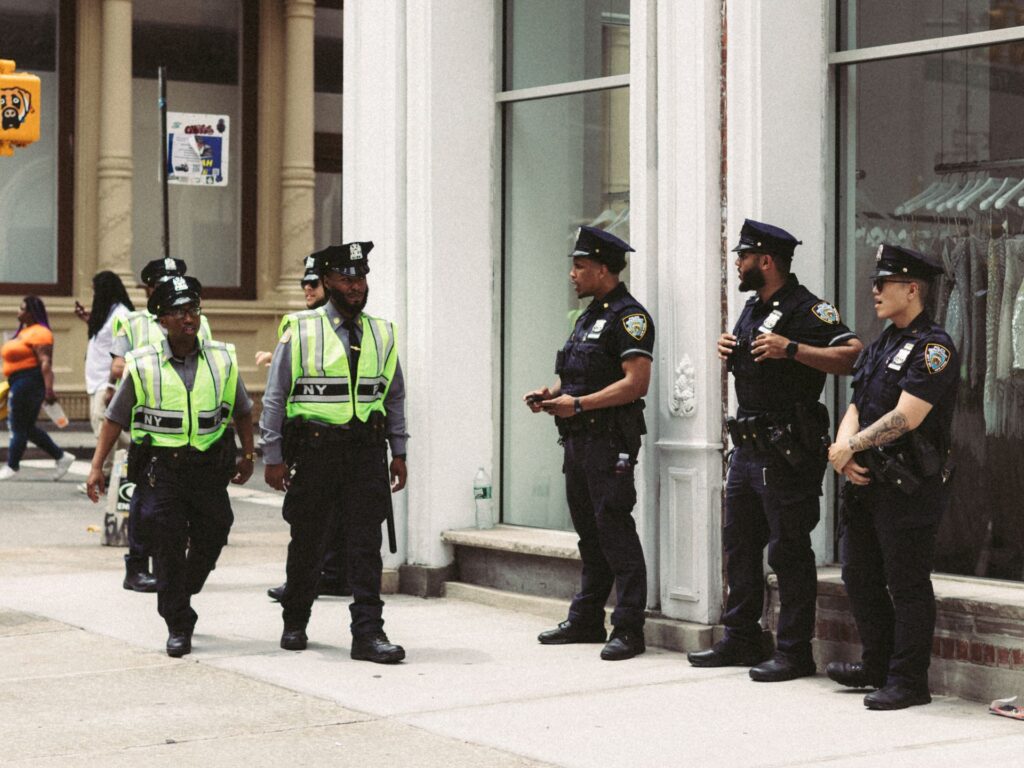
Investing in de-escalation training produces measurable outcomes that matter to security firms, in-house departments, and individual officers. Research from the National Institute of Justice found that after structured de-escalation programs, use of force and civilian injuries both dropped over 25%, while officer injuries fell 36%. Training improves security personnel’s communication skills and emotional intelligence, and regular training sessions enhance security teams’ de-escalation skills over time.
Training enhances public relations by projecting a professional and empathetic image. Training in the de-escalation techniques also reduces emotional fatigue for security personnel who handle conflict daily.
Key benefits for training buyers:
- Fewer physical interventions and use-of-force reports
- Lower complaint, grievance, and litigation rates
- Improved officer safety and reduced burnout
- Stronger public trust and client satisfaction
- Alignment with workplace violence prevention policies
- Smoother handoffs to law enforcement when needed
Officers and supervisors seeking deeper expertise can pursue a conflict resolution certification to complement these skills.
Core Skills Security Officers Learn
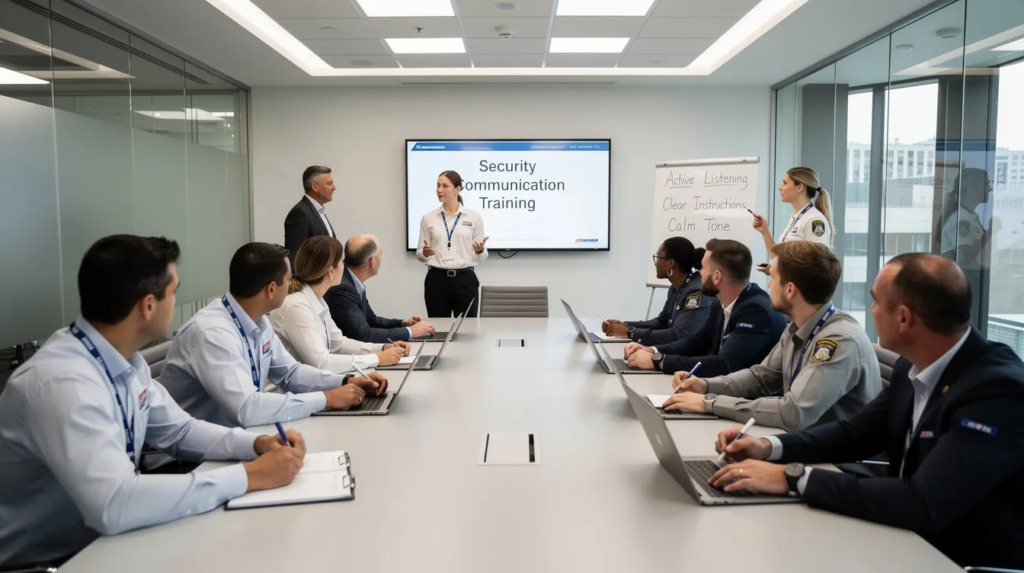
This is the core of the program. Training equips personnel with communication skills and emotional intelligence through a blend of theory, demonstrations, role-playing exercises, and structured feedback. Escalation techniques prioritize peaceful resolution over confrontation, and every skill is designed to be repeatable on patrol or at a fixed post.
Learn more about essential security officer skills that complement de-escalation training.
Verbal De-Escalation
Verbal de-escalation training is the foundation for resolving conflicts through words rather than physical force. Verbal de-escalation techniques include monitoring tone, volume, and inflection to match the emotional temperature of the situation. The HEARD method includes hearing, empathizing, apologizing, resolving, and diagnosing, and gives officers a repeatable framework. Calm communication reduces the chance of aggressive behavior.
Officers practice:
- Using non-judgmental language and offering choices instead of commands
- Setting clear boundaries while maintaining a respectful tone
- Managing profanity or insults without reacting defensively
- Redirecting conversations toward problem-solving
Emotional Self-Regulation
Effective de-escalation starts with officers managing their own stress, frustration, and fear. Techniques include tactical breathing, mental check-ins, and recognizing personal triggers. Officers train to remain calm even when filmed, insulted, or challenged, which supports building confidence and reduces impulsive escalation. Clear protocols help guards respond consistently to incidents rather than reacting emotionally.
Active Listening
Active listening means fully focusing on the speaker to understand their concerns, not waiting to give commands. Active listening helps individuals feel understood and validated, which often reduces aggression faster than any directive. Officers learn to paraphrase, ask clarifying questions, and acknowledge emotions so individuals feel heard without officers conceding on safety.
Situational Awareness
Tactical awareness involves reading the environment, body language, and group dynamics while communicating. Officers scan for exits, potential weapons, bystanders who might escalate, and cover positions. Security personnel must understand constitutional rights in public areas and adjust their approach accordingly. This awareness informs when to continue verbal de-escalation efforts and when to disengage or call for backup.
Developing strong security guard skills enhances situational awareness and response effectiveness.
Risk Assessment
Conflict de-escalation training must always be anchored in continuous risk assessment and behavioral assessment. Officers evaluate threat levels based on behavior, context, and available support. Regular training sessions ensure security teams stay updated on best practices for structured decision-making.
Questions officers learn to ask during incidents:
- Is this person impaired, in a mental health crisis, or acting with intent?
- What resources and backup are available right now?
- Can verbal techniques resolve this, or is a safety protocol needed?
- What are the legal and policy boundaries for my response?
Conflict Resolution
Conflict resolution moves beyond stopping an escalation toward reaching a safe, workable outcome. Officers learn to negotiate options, propose compromises within policy, and help parties save face. Techniques include separating disputants, documenting warnings, and setting clear next steps. These skills connect directly to broader leadership development, and officers moving into supervisory roles can benefit from leadership training certification.
Expand your professional security skills with detailed guidance on conflict management in our security guard skills blog.
Online De-Escalation Training for Security Officers
Peaceful Leaders Academy offers flexible online de-escalation training built for security guards and officers. Formats include self-paced modules, live virtual workshops, and blended models combining on-demand lessons with instructor-led practice. Scenarios cover trespassing, disorderly conduct, workplace disputes, and public safety interactions. Teams in government settings can explore dedicated government de-escalation training.
- Minimal disruption to shift schedules
- Consistent curriculum across locations
- Private cohorts for healthcare, education, corporate, and event security teams
- Certificate of completion for every participant
How De-Escalation Training Is Delivered and Assessed
Training programs can be delivered as stand-alone workshops or integrated into broader workplace violence prevention initiatives. De-escalation training should occur at least once a year to prevent skill decay, with refresher sessions reinforcing techniques through post-incident reviews and shift briefings.
Delivery and assessment elements include:
- Live virtual sessions, onsite instructor-led training, and asynchronous e-learning
- Knowledge quizzes and scenario-based discussions
- Observed role plays to verify skill acquisition
- Certificates of completion for compliance and audit documentation
- Manager guidance on coaching and reinforcing de-escalation tactics after training
Who Should Enroll in Security Officer De-Escalation Training
This training is designed for anyone in a security role who faces conflict or aggression as part of their daily work. It applies equally to armed and unarmed officers and to those working patrol, access control, or concierge-security hybrid positions.
Ideal participants include:
- Contract security officers and patrol staff
- In-house corporate and campus security teams
- Hospital and healthcare protective services officers
- Security supervisors, site leads, and field trainers
- New hires during probationary onboarding
- Training managers and security company owners, enrolling entire teams
Frequently Asked Questions About De-Escalation Training for Security Officers
It is structured training that teaches security officers to manage conflict, aggression, and crisis situations using verbal communication, emotional self-regulation, and risk assessment rather than relying on physical force as a first response.
Security guards are frequently the first to respond to conflict. Without de-escalation skills, minor incidents can escalate into injuries, complaints, or legal action that damages both the officer and the organization.
Any situation involving an agitated, non-compliant, or distressed person, including trespassing stops, access disputes, retail theft confrontations, hospital visitor conflicts, and event-related disturbances.
Yes. Research shows that structured de-escalation programs have reduced use of force and civilian injuries by over 25% in evaluated settings.
Absolutely. The communication, awareness, and decision-making skills apply regardless of whether an officer carries a weapon.
Options range from two-hour introductory modules to full-day and multi-session programs, depending on team size and the depth of content needed.
Yes. Every participant who completes the program receives a certificate of completion.
Yes. Private online cohorts, department-wide enrollment, and custom onsite sessions are available for teams of any size.
Online and blended formats consistently produce measurable improvements in knowledge, confidence, and communication behavior, especially when combined with scenario practice.
Core skills include verbal de-escalation, emotional self-regulation, active listening, situational awareness, risk assessment, and conflict resolution.
Organizations seeking advanced capabilities can pair this with a conflict resolution certification or leadership program.
Next Steps: Bring Effective De-Escalation Skills to Your Security Team
Structured de-escalation training gives security officers the tools to handle conflict calmly, reduce risk, and strengthen the professional image of every organization they serve. Getting started is straightforward: enroll your team in an online cohort or book an instructor-led workshop tailored to your industry and environment.
Visit the Online De-Escalation Training page to review course details, explore pricing, and request a proposal for your security team. Build a culture of calm, prepared, and professional security interactions that protect everyone involved.
Course Details
Learn to de-escalate individuals while attending to people’s psychological needs and regulating your own emotions.
Course Provider
Industries Served





PLA is recognized by the Society for Human Resource Management
to offer Professional Development Credits (PDCs) for SHRM-CP® or SHRM-SCP® recertification activities.