Online De Escalation Training
Skills to Calm Conflict Before It Becomes a Crisis
Workplace conflict doesn’t announce itself with a warning label. It shows up as a raised voice at a service counter, a tense silence during a team meeting, or an agitated patient in a crowded waiting room. How your staff responds in those first few seconds determines whether the situation resolves peacefully or spirals into something far more costly.
De-escalation training online gives professionals the structured, skills-based continuing education they need to handle these moments with confidence and calm, rather than focusing on control or restraint. Modern programs center on communication skills, active listening, and emotional regulation. Online course options make this training accessible for nurses, customer service teams, educators, social workers, security staff, supervisors, and managers, regardless of location or shift schedule. Effective de-escalation skills reduce workplace conflict, aggressive behavior, and crisis situations while improving psychological safety across the organization. Online de-escalation training provides a convenient way to learn conflict-resolution skills without pulling entire teams off the floor.
This page explains what de-escalation techniques look like in practice, who needs them most, how training online works, and what separates a high-quality program from a checkbox exercise.
What Is De-Escalation Training?
De-escalation training is instruction that teaches people how to recognize behavioral escalation and calmly de-escalate tense situations using communication, empathy, and self-awareness. It is not about winning arguments or physically managing people. It is about understanding what drives human behavior under stress and responding in ways that lower tension rather than raise it.
Common elements of any solid program include:
- Verbal de-escalation strategies (tone, word choice, pacing)
- Nonverbal communication awareness (posture, distance, facial expression)
- Emotional self-regulation tools (breathing, grounding, internal self-talk)
- Conflict resolution fundamentals (interests vs. positions, next steps)
Courses typically include verbal techniques and conflict management strategies tailored to specific industries. De-escalation training focuses on emotional intelligence and recognizing stress triggers so staff can intervene early.
The need for effective de-escalation has grown significantly in recent years as frontline workers face increasing challenges from customer hostility, patient frustration, and public-facing community tensions. These are daily realities for millions of professionals.
It helps to understand the distinction between related disciplines. De-escalation addresses immediate, in-the-moment flare-ups. Crisis prevention training focuses on anticipating and avoiding dangerous situations before they start. Broader conflict resolution training handles ongoing disputes, negotiations, and structural workplace conflict. Most professionals need elements of all three, and many programs now bundle them together.
Many programs offer de-escalation certification online, with assessments, knowledge checks, and a certificate of completion that satisfies compliance and professional development requirements. Some can be completed quickly, making it feasible even for the busiest teams.
Why De-Escalation Skills Matter in Today’s Workplace
Staffing shortages, shifting customer expectations, and heightened tensions have pushed workplace conflict to levels many organizations were not prepared for. De-escalation skills are now essential in:
- Customer service counters and call centers where frustrated callers escalate quickly
- Hospital units and ambulatory clinics dealing with patient and family distress
- Retail floors where disputes over returns, policies, or wait times turn hostile
- Schools and universities where educators manage student and parent conflict
- Social services offices where clients face high-stakes personal situations
- Hospitality venues managing guest complaints under pressure
De-escalation training improves workplace safety and communication across all of these settings. When employees know how to listen, validate, and respond without matching another person’s hostility, minor complaints stay minor. De-escalation training reduces workplace violence incidents and can prevent escalation of conflicts before they become HR or security events.
Strong communication skills and active listening reduce customer conflict and employee disputes. Emotional regulation and self-regulation help staff avoid the instinct to mirror anger or defensiveness, keeping customer interactions calm and professional. Effective training improves employee safety and morale, and organizations that invest in these skills consistently see reduced burnout, better retention, and improved patient or customer satisfaction scores. Training helps employees manage aggression in high-stress roles rather than simply endure it.
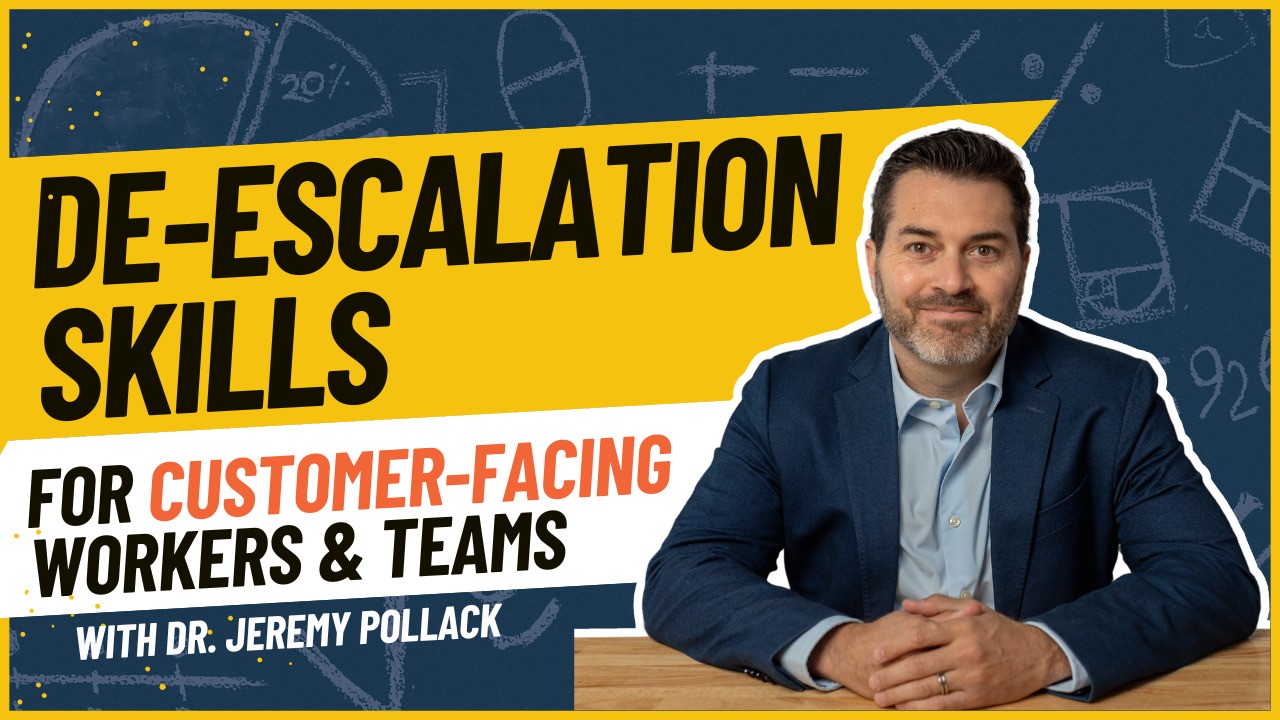


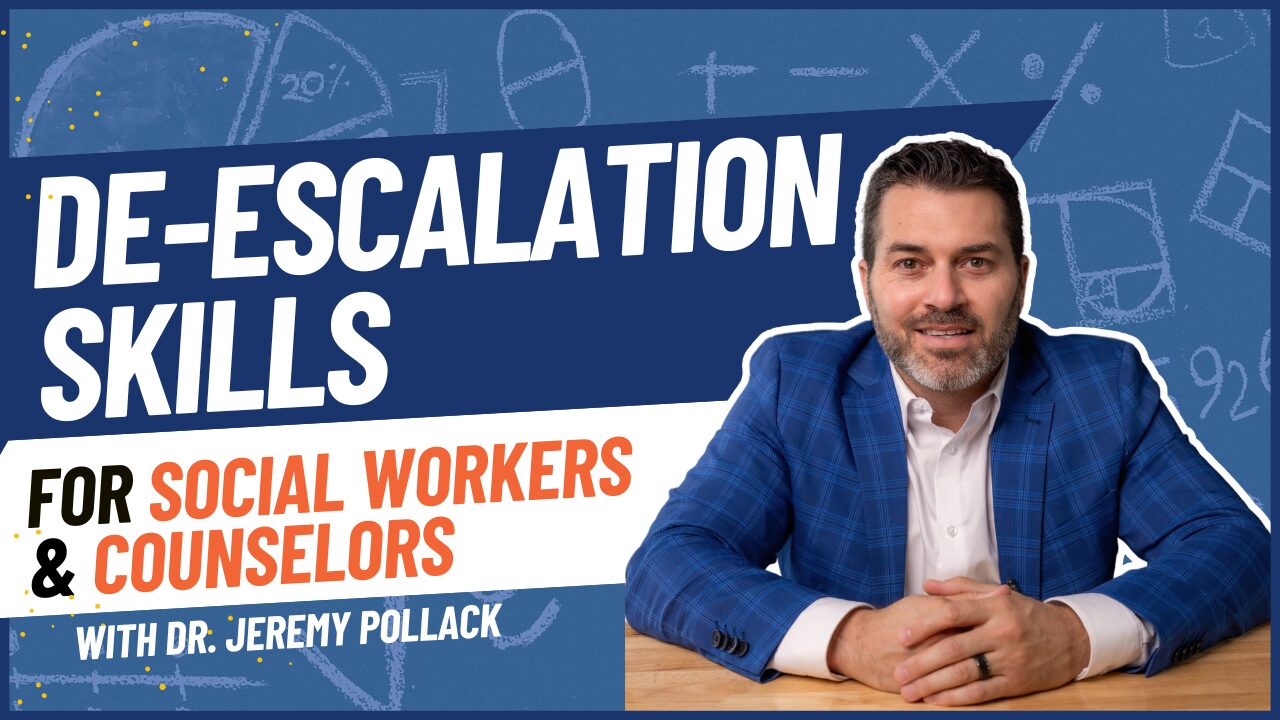
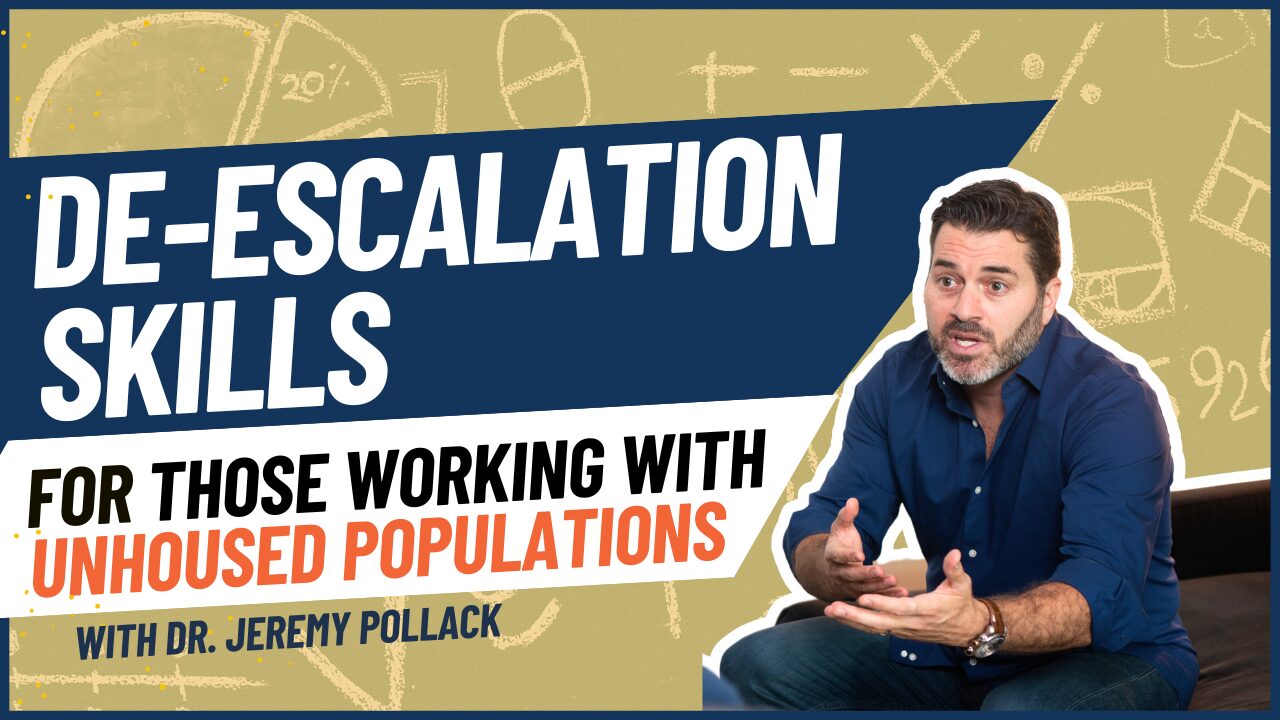


Dr. Jeremy Pollack
Course Instructor
Dr. Jeremy Pollack is a leader in the field of workplace conflict resolution and peacebuilding. He is the Founder of Pollack Peacebuilding Systems, an international conflict resolution consulting firm. Dr. Pollack coaches and trains executives and employees at a variety of levels and industries, from Fortune 500 companies to major non-profits. He has a Ph.D. in Psychology and an M.A. in Negotiation, Conflict Resolution, and Peacebuilding. Read more about Dr. Pollack!
The Psychology Behind Escalation and De-Escalation
Effective de-escalation is rooted in understanding human psychology, not in overpowering or manipulating people. This is a critical distinction, and it is one of the reasons psychology-based training produces better outcomes than scripted responses alone.
When a person perceives a threat, whether to their dignity, safety, fairness, or sense of control, the brain activates a fight or flight response. Heart rate climbs, adrenaline floods the system, and the prefrontal cortex (responsible for reasoning and impulse control) becomes less accessible. This is emotional flooding. You see it in a customer whose voice is rising, a patient who begins pacing, or a colleague who shuts down entirely during a disagreement.
Perceived threats drive aggressive behavior and confrontation in workplace conflict more often than actual danger does. A patient who feels ignored, a customer who is told “that’s not our policy,” or an employee who believes feedback is unfair can all experience triggered emotions that bypass rational thought.
Escalation techniques work by lowering perceived threat. Empathy, validation, and calm verbal communication signal safety to the other person’s nervous system, helping them move out of fight-or-flight mode and back into a state where conversation is possible. Emotional regulation involves learning to manage one’s own reactions under pressure so you can stay grounded while the other person is flooded. Situational awareness involves recognizing early warning signs of escalating behavior before they reach a tipping point.
Training online should include the practical psychology of conflict, not just scripts, so learners can adapt to the diverse crisis situations they encounter on the job.
Why Conflicts Escalate Instead of De-Escalate
Picture this: a customer approaches a retail counter, visibly frustrated after waiting twenty minutes. Instead of acknowledging the wait, the employee immediately explains the return policy. The customer’s frustration doubles. Within seconds, voices are raised, and a manager is being called.
This is a pattern, not an anomaly. Staff without training make predictable mistakes that turn manageable tension into full-blown confrontation:
- Arguing facts too early before the other person feels heard
- Interrupting or cutting someone off mid-sentence
- Invalidating emotions with phrases like “calm down” or “there’s no reason to be upset.”
- Matching emotional intensity by raising their own voice or becoming defensive
- Slipping into power struggles by asserting authority instead of seeking understanding
- Poor listening combined with judgmental language
Poor listening, rigid policy enforcement without explanation, and dismissive body language can quickly turn a minor complaint into a serious confrontation. The focus of good de-escalation training is on proactive, empathetic communication to prevent a conflict from escalating in the first place.
Trained professionals respond differently. They pause, acknowledge the emotion, ask a clarifying question, and offer a path forward. Escalation training online should give concrete examples, scripts, and role-play scenarios based on real-life scenarios to replace these unhelpful habits with more effective responses.
Core De-Escalation Skills Every Online Course Should Teach
High-quality de-escalation training online is built around a clear, teachable skill set rather than abstract theory. The skills below represent the competencies learners should expect from any serious online course. Each one should be practiced through realistic scenarios from healthcare, customer service, education, and social services settings.
These skills also support broader conflict resolution training and continuing education requirements in many professions. Participants can earn continuing education units through some courses, making the investment count toward professional credentials.

Emotional Self-Regulation and Emotional Intelligence
Emotional self-regulation is the ability to notice and manage your own stress, anger, or anxiety in real time during difficult conversations. Without it, even well-intentioned staff mirror the escalation they are trying to reduce.
Training should teach practical tools: brief grounding techniques, breathing strategies, and internal self-talk for staying calm. Emotional regulation training builds muscle memory for staying calm in stressful situations through repetition and practice. Online training allows for practicing emotional regulation through interactive simulations where learners face escalating scenarios and practice their responses without real-world consequences.
Emotional intelligence connects to recognizing your own triggers, understanding others’ emotions, and choosing responses that de-escalate rather than inflame conflict. Online modules should include reflection exercises, self-assessments, and workplace examples for nurses, customer service reps, and supervisors. The connection between emotional regulation training and reduced burnout, fewer regretted comments, and more constructive feedback conversations is well-documented in the research.
Active Listening for De-Escalation
Active listening means listening to understand rather than to respond. It requires focusing on the other person’s experience and needs before formulating your reply.
Core techniques include:
- Paraphrasing what the person said
- Reflecting feelings (“It sounds like you’re frustrated by…”)
- Asking open-ended questions
- Checking for understanding before moving to solutions
Effective communication includes active listening and nonverbal cues, working together. Participants learn active listening and nonverbal cues in de-escalation training as foundational skills. Active listening can quickly de-escalate by showing respect and reducing the sense of being ignored or dismissed.
A good online course should include short video demonstrations and practice prompts for typical situations like angry customers or upset employees. Active listening is foundational for all verbal de-escalation and conflict resolution work.
Verbal De-Escalation Techniques
Verbal de-escalation uses words, tone, and pacing to calm heightened emotions while still maintaining boundaries and safety. Verbal de-escalation training teaches respectful dialogue techniques that work across industries.
Core tactics include:
- Calm, measured tone of voice
- Simple, clear language
- Respectful address (using the person’s name when possible)
- Offering choices rather than ultimatums
- Focusing on shared goals (“Let’s see what we can work out together”)
Verbal intervention requires using specific language, tone, and volume to communicate respect. Participants learn to communicate calmly in stressful situations through repeated practice with these techniques. Scripts and phrase examples can be tailored for healthcare, retail, call centers, government offices, and school settings.
Online training should allow learners to hear and practice different responses through interactive scenarios or recorded role-plays. Avoiding inflammatory phrases, sarcasm, or threats is critical, as any of these can immediately escalate confrontation.
Empathy, Validation, and Psychological Safety
Empathy means accurately sensing and acknowledging another person’s feelings, even when you disagree with their behavior or perspective. Validation is the statement that conveys, “Your feelings make sense given what you’re experiencing,” without necessarily agreeing with demands.
Empathy and validation reduce defensiveness and help people feel safe enough to step down from fight-or-flight mode. Managing high-stress encounters requires building rapport and providing resources so the other person sees a path forward.
Concrete phrases work across settings:
- Patient conflict: “I can see the wait has been really frustrating. Let me find out what’s happening.”
- Customer complaint: “That’s not the experience we want you to have. Let’s fix this.”
- Employee conflict: “I hear that you feel the workload isn’t balanced. Let’s talk through what’s going on.”
This skill builds psychological safety at work, where employees and customers feel heard rather than silenced or dismissed.
Non-Verbal Communication and De-Escalation
Body language, facial expression, personal space, and posture can either de-escalate or inflame a situation, even when words are perfectly calm. Nonverbal communication is often the first thing an agitated person reads.
De-escalation-supportive behaviors include:
- Open stance with relaxed hands visible
- Non-threatening eye contact (not staring)
- Appropriate physical distance
- Slow, deliberate movements
Non-threatening body language can help de-escalate a situation before a single word is spoken. Body language techniques are crucial for diffusing tense situations across all industries. Training teaches personal space management to reduce the need for direct intervention, which is especially important in security roles, social work, and healthcare, where physical presence can feel intimidating.
Online courses can use short video clips and breakdowns to help learners spot unhelpful non-verbal signals like looming over someone or crossing arms. Cultural awareness matters here as well, since interpretations of body language vary, and good training addresses this sensitively.
Conflict Resolution Fundamentals
De-escalation is often the first phase of a broader conflict resolution process, not a complete solution on its own. Once emotions have cooled, there is still a problem to solve.
Basic conflict management concepts that should be included:
- Interests vs. positions (what someone wants vs. why they want it)
- Exploring options collaboratively
- Agreeing on next steps with clear accountability
Crisis intervention techniques help manage high-stress situations and behavioral challenges that go beyond routine disagreements. For deeper skill development, conflict resolution training is a logical next step after foundational de-escalation skills. Online modules should help learners distinguish when they are de-escalating immediate emotions versus negotiating long-term solutions. Managers use both de-escalation and problem-solving regularly in performance conversations and team disputes.
Personal Safety Awareness and Boundaries
De-escalation training is not about taking unsafe risks. It includes recognizing when to set limits, exit, or involve additional support. Training includes techniques for managing challenging individuals while keeping everyone safe.
Online courses should teach cues of dangerous behavioral escalation, such as threats, invasion of personal space, or sudden movements, along with appropriate responses. This content should focus on situational awareness and effective communication, not physical tactics, to align with a workplace-focused approach to public safety.
Staff can use de-escalation techniques while still following organizational safety protocols. Clear workplace procedures for calling security or supervisors should be reinforced within training scenarios so that learners know exactly when and how to engage support.
The Peaceful Leaders Academy Approach to De-Escalation
Most de-escalation training focuses primarily on managing other people’s behavior. At Peaceful Leaders Academy, we believe effective de-escalation starts with managing your own emotional state first. Our approach emphasizes emotional self-regulation as the foundation for all conflict interactions, helping learners develop the inner calm and resilience needed to navigate tense situations successfully.
We integrate the psychology of conflict and human behavior with practical communication skills tailored to workplace realities. By focusing on understanding triggers, recognizing escalation patterns, and applying a simple, evidence-based de-escalation process, our courses empower professionals to respond with empathy and confidence. This philosophy supports not only immediate conflict management but also fosters healthier workplace relationships and psychological safety.
Our industry-specific training modules reflect real-world scenarios faced by healthcare workers, customer service professionals, educators, and social service staff. Combined with expert instruction from Dr. Jeremy Pollack, our programs deliver practical tools grounded in science and tested in practice, setting Peaceful Leaders Academy apart as a leader in online conflict de-escalation training.
How De-Escalation Training Online Works
Online de-escalation training is delivered in several formats, each suited to different organizational needs:
Learning Formats
Select the format that best fits your goals, schedule, and learning style.
Self-Paced Courses
Learn at your own pace with on-demand modules designed for busy professionals seeking flexibility and convenience.
Live Virtual Workshops
Interactive facilitator-led sessions that encourage discussion, collaboration, and practical application in real time.
Blended Learning Programs
A structured combination of coursework, workshops, coaching, and follow-up activities that drive deeper skill development.
Microlearning Refreshers
Short, focused learning experiences that reinforce key concepts and support long-term retention after training.
Typical online courses combine video lessons, interactive scenarios, knowledge checks, and downloadable job aids. Online training offers a safe environment for individuals to learn without real-world consequences, and flexibility in online training allows individuals to learn on their own schedule.
Repetition in training builds muscle memory for applying techniques in high-stakes situations, which is why the best programs include ongoing reinforcement rather than one-time events. Many programs offer de-escalation certification online with assessments that verify understanding of key de-escalation techniques and processes.
Organizations should look for: industry-relevant examples, clear learning outcomes, evidence-based frameworks, and opportunities for practice and feedback.
Common Workplace Situations Where De-Escalation Skills Are Essential
De-escalation is relevant far beyond security and law enforcement. It is now a core competency across public-facing and internal roles. Here are scenarios that good online training should prepare staff to handle:
- Angry customers at retail checkouts are disputing charges or return policies
- Frustrated patients and family members dealing with long wait times or unclear billing
- Coworkers clashing over workload during high-pressure project deadlines
- Hostile community members at public meetings directed at government employees
- Difficult feedback conversations where an employee becomes defensive (resources like receiving feedback can complement this skill)
- Virtual meeting confrontations where tone and intent are easily misread
- Crisis situations involving individuals in acute emotional distress
Good online training uses realistic, job-specific case studies so learners can immediately see how to de-escalate situations they face daily. Each scenario connects back to specific skills: active listening for the upset patient, empathy for the defensive employee, verbal de-escalation for the angry customer, and self-regulation throughout all of them.
Who Benefits Most from De-Escalation Training Online?
While everyone can benefit from de-escalation skills, some roles encounter conflict and crisis situations far more frequently. Key audiences include:
- Customer service teams and call center staff
- Retail employees and hospitality staff
- Healthcare workers, nurses, and physicians
- Educators and school support staff
- Social workers and case managers
- Frontline government employees
- Security professionals and first responders
Supervisors, managers, HR professionals, and Learning & Development leaders also need these skills because they must model and coach de-escalation for their teams. De-escalation skills enhance communication in tense situations regardless of industry or role.
De-escalation training online is especially helpful for geographically dispersed organizations and hybrid or remote teams dealing with conflict over email and video calls. Leaders who also access conflict coaching can further support staff in applying de-escalation skills to long-term workplace conflict that training alone cannot resolve.
What to Look For in a High-Quality Online De-Escalation Course
Not all de-escalation training online is created equal. Organizations should evaluate content quality, instructor credentials, and real-world relevance before enrolling their teams.
Key criteria to assess:
- Psychology-based approach that explains why techniques work, not just what to say
- Clear step-by-step de-escalation process that learners can remember under pressure
- Evidence-based techniques supported by research, not just anecdotes
- Industry-specific modules (healthcare, education, retail, hospitality, social services) rather than generic content
- Assessments and scenario-based practice that test application, not just recall
- A recognized certificate of completion or de-escalation certification
De-escalation training certification validates conflict management skills and demonstrates competency to employers and regulators. Certification is awarded after completing an accredited de-escalation course that meets established standards.
Questions to ask vendors:
- How often is the course content updated?
- Does it address virtual and remote interactions?
- How is learner progress tracked and reported?
- What credentials does the instructor hold?
- Are scenarios customized for our industry?
How De-Escalation Training Supports Ongoing Professional Development
De-escalation training is not a one-and-done event. It fits into a broader continuing education strategy for professionals in healthcare, social work, education, security, and customer service. These skills complement leadership development, emotional intelligence programs, and formal conflict management training.
Many organizations now integrate de-escalation modules into annual compliance or safety training due to increased focus on workplace violence prevention. Skills such as receiving feedback, managing difficult conversations, and mediation are more effective when built on solid de-escalation fundamentals.
Positioning de-escalation courses as part of a long-term learning pathway, rather than a single workshop, produces the strongest results. Periodic refreshers, peer practice, and integration with leadership coaching create lasting behavior change.
Getting Started with De-Escalation Training Online
Here is a practical roadmap for organizations ready to invest:
How to Implement Conflict Resolution Training Successfully
Follow these five practical steps to introduce conflict resolution training and achieve measurable results across your organization.
Assess Risk Points
Identify your highest-conflict touchpoints, including reception desks, phone queues, patient rooms, service counters, and checkout areas.
Select the Right Course
Choose a training program that aligns with your industry, team size, organizational culture, and learning objectives.
Run a Pilot Program
Start with a high-conflict department or team to test engagement, gather feedback, and validate content relevance.
Scale Organization-Wide
Expand implementation across departments using lessons learned from the pilot and participant feedback.
Measure Outcomes
Track KPIs such as incident reports, supervisor escalations, customer satisfaction scores, and employee engagement.
Create simple pre- and post-training evaluations to capture changes in confidence and ability. Follow up with brief team huddles to review de-escalation techniques, peer role-plays during meetings, and integration into onboarding for new hires.
De-escalation skills are not a luxury or a nice-to-have. They are a core professional competency for anyone who works with people. The organizations that invest in these skills now will build safer, calmer workplaces where employees can engage with confidence, and customers, patients, students, and community members feel respected. Start by identifying where your team needs support most and choose a program that meets them where they are.
Training Testimonials
Frequently Asked Questions




PLA is recognized by the Society for Human Resource Management
to offer Professional Development Credits (PDCs) for SHRM-CP® or SHRM-SCP® recertification activities.